ECO HOUSE IMPROVEMENTS

Information about energy-saving improvements to our house

ELM AVENUE, BEESTON
  • Home
  • About
  • Contact
  • Windows
  • Walls etc
  • Water
  • Electricity
  • Problems
  • Dual-flush toilet
  • New Kitchen

Our names are Janet and Martyn.  We bought the house over 40 years ago, when we moved to the area.  We had young children at the time and didn’t do much to the house initially, apart from repairs.  In 2009 we started to have work done to save energy and reduce the amount of water we use.

We hope that by sharing information about work we have had done on our house we can help other people find out more about it  and inspire them to do something similar themselves.  We had already had loft insulation done some time ago but cavity wall insulation was not possible, because the walls are solid.

We forgot to photograph the first rooms during the insulation work, so the pictures of the work in progress are of the later ones.  (Once it is finished, the presence of the insulation is not so obvious.)  All of the house has now been insulated and the the kitchen and utility room are almost finished.  We'll add more information as time permits.

We are also members of Greening Beeston - find out more here.
CLICK ON THE TOPICS BELOW TO FIND OUT MORE:

  • Double-glazing of windows and doors to reduce heat loss.
  • Solar PV panels to generate electricity.
  • Grey water system to use rainwater for flushing toilets.
  • Internal insulation on all outside walls, ceilings and floors to reduce heat loss.
  • Problems/Inconveniences we encountered.

Below are more details what has been done, both large and small.

WARNING ABOUT DUAL-FLUSH TOILETS

We bought a dual-flush toilet, which we expected to help us save water.  Unfortunately, it didn't function properly and water was very slowly but continuously overflowing.  Click here to find out more about it, in case yours is doing the same.

MEASURES TO SAVE ENERGY AND WATER

EXISTING ENERGY-SAVING MEASURES:
  • Self-closing hinges on the 3 doors leading from the quite large hall, to keep the heat in the rooms where we sit.
  • Secondary glazing in hall, stairs and landing.  (We don't know why those windows were chosen.)
  • Some loft insulation.

EARLY WORK THAT WE HAD DONE:
  • Improved loft insulation.
  • Thermostatic vales on radiators, so that room temperatures can be controlled individually.

WATER-SAVING MEASURES:
  • Rainwater harvesting, initially for watering the garden.
  • Permeable paving on part of drive and front path (avoids sending so much water to the sewage system).
  • Enhanced rainwater harvesting, for flushing toilets as well as for the garden.
  • Dual flush toilets.
  • New bath chosen of smaller capacity.

HEAT-SAVING MEASURES:
  • Double-glazing of all windows and doors, including draught-proofing.
  • Radiator panels behind the radiators on external walls.
  • For each radiator under a window, a blind was fitted inside the window recess (curtains left open).
  • Reduced time when central heating switched on (off 30 mins. before leaving house/going to bed).
  • Radiators re-sited on internal walls, where possible (included with internal insulation).
  • Heat-exchanging extractor fans in kitchen and bathrooms.
  • Internal wall insulation of all rooms, also ceilings and floor as appropriate (sloping ceilings not protected by loft insulation; ceilings where loft inaccessible; floor over porch etc.).

ELECTRICITY-SAVING MEASURES:
  • Low energy light bulbs, with LEDs in some cases.
  • Solar PV panels, to generate electricity.
  • Optimiser to increase the efficiency of the solar panels.

WASTE REDUCTION:
  • Compost bin for most garden rubbish, pet waste, a little paper and cardboard – used in garden.
  • Wormery for kitchen waste (apart from meat or fish) – worm compost also used in garden.

KEEPING COOL IN HOT WEATHER (reducing the need for fans or air-conditioning):
  • All the insulation and double-glazing helps keep the house cool in hot weather, although after several days the heat does creep in.
  • The blinds we had installed to keep heat in during cold weather also helped to keep heat out.  Whenever the sun is shining on any window,  a blind or curtains will reduce the heat coming in (especially if they are pale in colour).
  • When the air is warmer outside, we keep all windows and doors shut.  If it is cool at night, we open as many windows as possible to create a draught and encourage cool air to circulate.
Picture
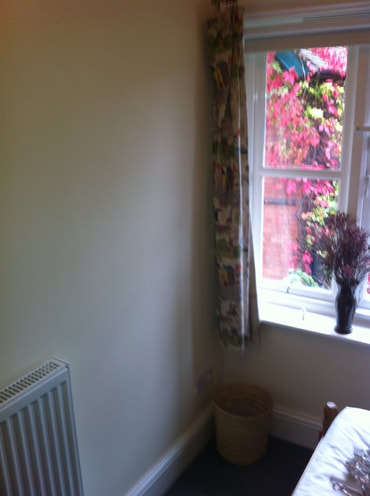
Finished bedroom after internal insulation, re-plastering and decorating have been completed. The radiator has been re-sited on an inside wall to avoid heat loss to outside.
Picture
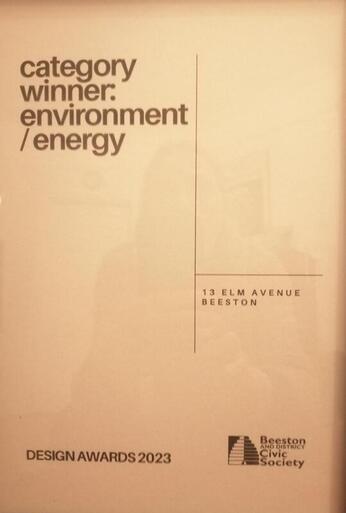
Our house won a Beeston Civic Society Design Award for environment/energy on 8th November 2023.
Powered by Create your own unique website with customizable templates.